
The Cough and the Nembutsu
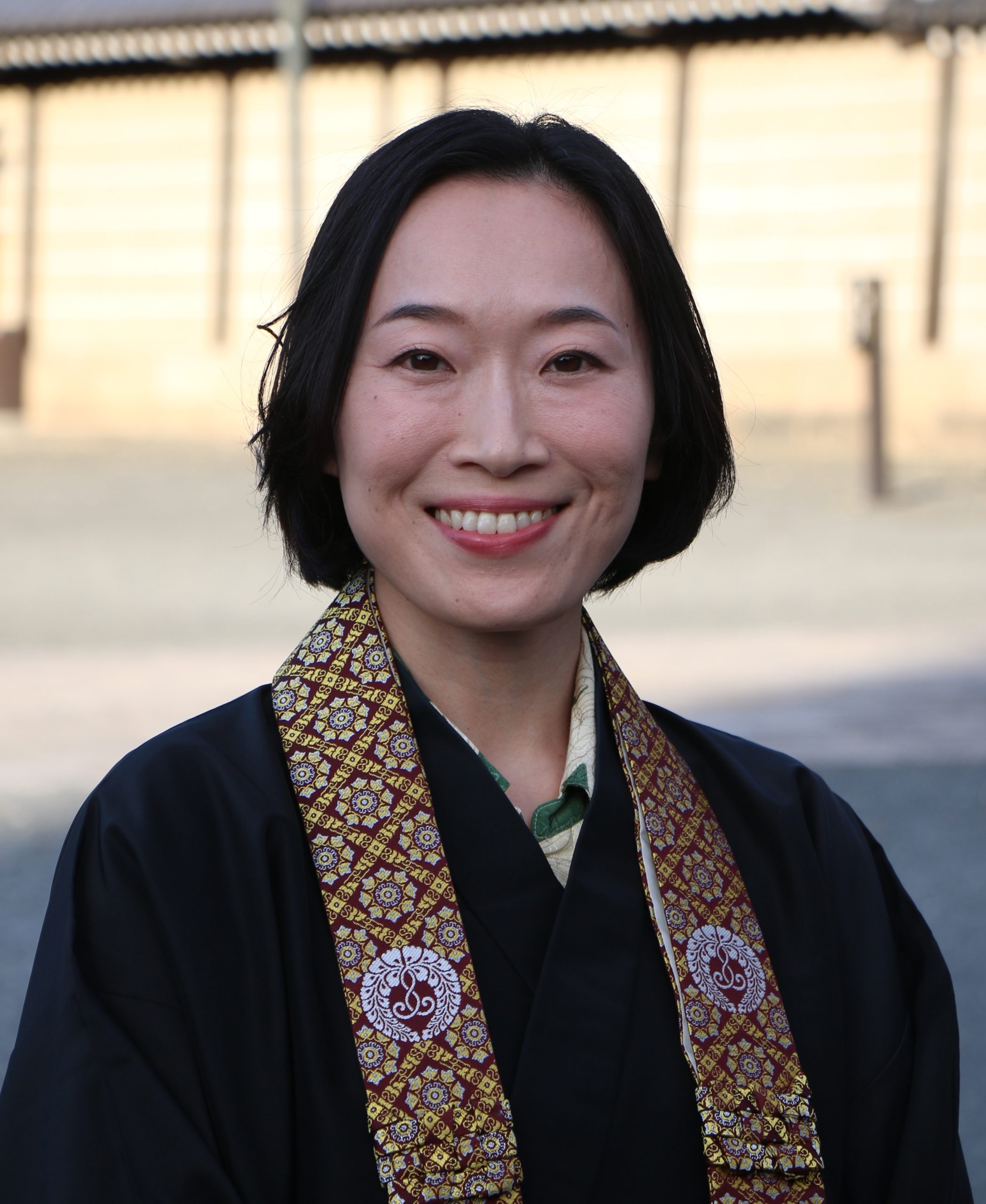
Reverend Yukari Torii
Resident Minister, San Fernando Valley Hongwanji Buddhist Temple
This past April, I came down with bronchitis and suffered through weeks of relentless coughing. For about a week, I literally could not stop coughing and could barely sleep. A bad coughing fit takes over your whole body—the force of it reverberates right into your head. There were moments when I seriously thought my head might explode. I’ve had pneumonia before, and I’ve had COVID, but I don’t think I had ever suffered quite this much.
While I was in the middle of all that coughing, a poem came to mind:
A cold comes—and the cough just comes with it. Amida Buddha’s reach came over me.
And the nembutsu just keeps coming, coming.
This poem was written by Saichi Asahara, a devoted Jodo Shinshu follower who lived in the early twentieth century. Saichi was not a professional poet, a scholar, or a priest. He worked as a ship’s carpenter in his youth and later became a maker of wooden sandals—geta. He was not formally educated and taught himself to read and write by watching others. Throughout his life, in the middle of ordinary moments, a feeling of joy would simply rise up in him, a sense of being embraced by Amida Buddha’s compassion, and he would write it down on whatever was nearby, often the wood shavings at his feet. He left behind nearly seven thousand such poems. More than thirty years after his death, D.T. Suzuki introduced his words to the world.
In this poem about the cough, Saichi expresses his joy at recognizing Amida Buddha’s working reaching him, not because he sought it out, but simply because it is there. Amida Buddha is not a creator god, nor a being who controls our lives. Amida Buddha is the very embodiment of limitless wisdom and boundless compassion. This reality, beyond what the human mind can fully grasp, is given form so that we can relate to it: in the statues or painted images in the Naijin (inner altar) of the Hondo. When that same reality takes the form of words, it becomes Namo Amida Butsu, the name of Amida Buddha. That is why in some temples and home altars, the written characters 南無阿弥陀仏 are themselves enshrined as the object of reverence.
Literally translated, Namo Amida Butsu means something like: “I entrust my whole self to Amida Buddha, the Buddha of infinite light and infinite life.” In the Pure Land tradition before Shinran Shonin, this movement from me toward Amida Buddha was at the center of practice. Shinran Shonin, however, reoriented this understanding. He said: the reason that feeling of entrusting arises in me at all is because Amida Buddha is already reaching toward me, saying, “I embrace all living beings and free them from suffering—please leave everything to me.” Amida Buddha moves first.
When we get sick, bronchitis, a cold, whatever it may be, the coughing is not something we choose to do. Symptoms appear because a virus has made its way into our body. We cannot see the virus, but the cough tells us it is there. Saichi understood his nembutsu in exactly this way. The fact that Namo Amida Butsu arises from his mouth is proof that Amida Buddha’s working has reached him. The nembutsu is the cough, the unmistakable sign that something has arrived.
Shakyamuni Buddha described Amida Buddha’s compassion and wisdom this way: “Once grasped, one is never abandoned”—a working that embraces all living beings without distinction, letting no one fall outside its reach. Shinran Shonin took this further, saying that Amida Buddha works to “pursue and grasp the one who seeks to run away,” and then to “take in, receive, and embrace” that person. This may sound alarming at first. But what Shinran Shonin is pointing to is this: Amida Buddha’s working, the deep wish to free us from the suffering that comes from being caught in our own self-centered thinking, reaches us whether we have invited it or not.
We do not want to get sick. We get vaccinated, we wear masks, we do what we can, and still, sometimes, the virus finds us. That dynamic is not unlike how Amida Buddha’s working reaches us, described as “pursue and grasp the one who seeks to run away.” The bronchitis virus entered my body regardless of my own will. And the cough that rose up from deep in my chest, whether I wanted it to or not, was the proof. In the same way, when Namo Amida Butsu arises from our mouths, it is proof that Amida Buddha’s deep wish for us has already arrived.
I believe this is what Saichi was sitting with. Even in the middle of a coughing fit, he recognized Amida Buddha’s compassion at work in his life. He wrote another poem that speaks to this:
It is not I who wish toward the Buddha, it is the Buddha whose wish reaches me. Namo Amida Butsu.
Amida Buddha’s wish reaches us first. And Saichi wrote this as well:
It is not I who wish toward the Buddha, it is the Buddha who wishes toward me. Namo Amida Butsu.
Even when I forget. Even when I am asleep. Amida Buddha’s caring for me never stops. At every moment, I am held within that working.
At our Sunday services, we recite Namo Amida Butsu together. But it is not a requirement. There is no condition that says you must say the nembutsu in order to be embraced. Shakyamuni Buddha taught that Amida Buddha’s wish is simply this: please, hear my name. Shinran Shonin said that what matters most is to receive that wish openly and sincerely, to simply let it in.
So why do we recite nembutsu together? Because when we say Namo Amida Butsu, those words, Amida Buddha’s own wish, enter our own ears. There may be moments in our lives when we feel deep gratitude for Amida Buddha’s compassion. But that feeling is not with us every hour of every day. Reciting nembutsu intentionally reminds us of what is always already true: that Amida Buddha works to “pursue and grasp the one who seeks to run away” and that “once grasped, one is never abandoned.” And perhaps, as Namo Amida Butsu becomes familiar, something our ears know well, it will begin to arise on its own, naturally, from our mouths.
Amida Buddha’s wish comes first. It reaches us. And from that, the nembutsu, like a cough, simply comes.
Through my own very unplanned experience with bronchitis, and through Saichi’s poem, I was reminded, in a very personal way, of the depth of Amida Buddha’s compassion that is always embracing us.
Namo Amida Butsu.