
The Compassionate Light That Never Tires
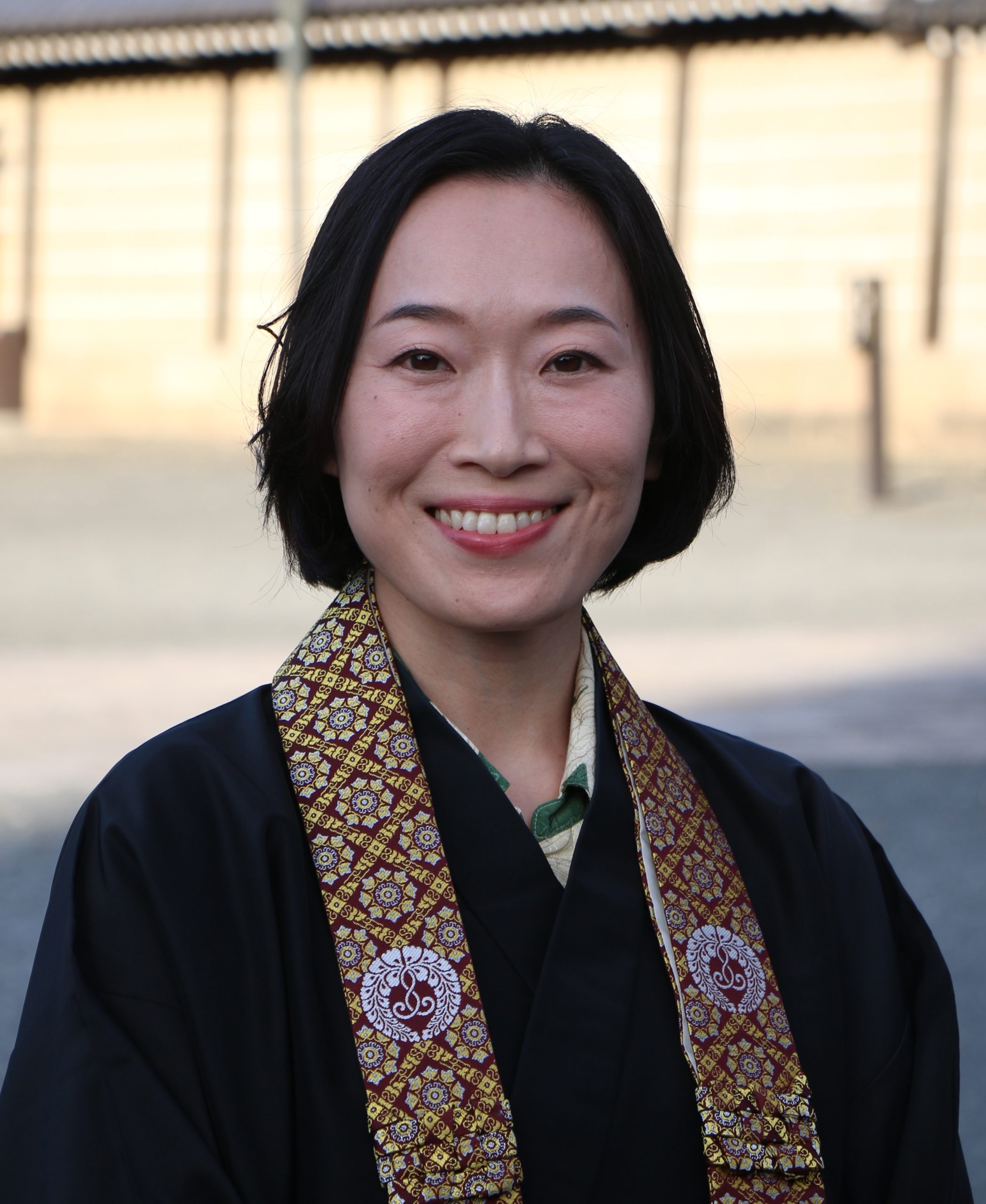
Reverend Yukari Torii
Resident Minister, San Fernando Valley Hongwanji Buddhist Temple
Shinran Shonin (Venerable Shinran) expressed the nature of Amida Buddha’s great compassion in this wasan poem.
My eyes being hindered by blind passions, I cannot perceive the light that grasps me;
Yet the great compassion, without tiring, Illumines me always. (CWS, p. 385)
Shinran Shonin teaches us that Amida Buddha’s great compassion is a constant presence—a warm, illuminating light that keeps thinking of us, cares for us, and shines upon us without ever growing tired or giving up, whether we notice it or not.
There’s someone in my own life who has given me a glimpse of what that “never-tiring” love actually feels like: my grandmother back in Japan.
My grandmother is 98 years old. Thankfully, she is in good health and has a sharp mind. This grandmother is my mother’s mother. I grew up in the same house with her from the day I was born. My mother has since passed away, but my father and grandmother still live there together.
Since going off to college I spent all my years in Tokyo, away from that home. But no matter how long I’d been away, my grandmother always looked forward to my visits. Even if I could only stay for a short while, the moment she saw my face, she would light up. “I’m so glad you’re here. Thank you for coming.”
And then, the moment I started packing to head back to Tokyo, her mission would begin. What I can only describe as the Gift Attack.
“Yukari, you love apples, right? These apples are delicious! We have so many right now, so take as many as you want!” “I remember you said you liked this carrot juice, so I bought a whole case for you.” “Are you getting enough nutrition? This supplement is supposed to be really good. Why don’t you take a box?”
She just wanted me to eat well, stay healthy, and be happy. All of it was her love, offered in the form of something she could hand me. If I had simply said, “Thank you, Grandma,” and received it all, she would have been overjoyed.
But if I’m being honest, I didn’t always meet her where she was.
Here in Los Angeles, I could load everything into a car. But in Japan, we travel by train, and I couldn’t carry all those bags. My bag with the laptop alone already felt like too much.
So I’d say, “Grandma, I really can’t take all this.” She’d counter with, “Then I’ll mail it to you!” And more often than not, I’d say, “No, please don’t. The shipping costs more than the juice itself,” thinking I can get everything in Tokyo. In my head, I was being practical. But in reality, I was turning away from her warmth.
When I finished packing and was ready to leave, she would first see me off at the front door. Then, despite her aching back, she would make her way to the back gate, the one that faces the road toward the station, just to catch one last glimpse of me and call out a final goodbye.
And as I walked toward the station, I would feel a quiet pang of regret. Once again, I wasn’t able to truly receive her love.
Whenever I feel that regret, there’s a scene that always comes to mind, a scene from Kiki’s Delivery Service.
It’s a Studio Ghibli film from 1989. The story follows a young witch named Kiki, who leaves home on the night of a full moon to make her way in the world, and starts a delivery service in a seaside town.
One of her clients is a kind and warm-hearted woman—Madame—who wants to send her granddaughter a birthday gift: her signature herring pie. When Kiki arrives to pick up the delivery, the electric oven broke down, so she helps Madam bake the pie in the old wood-fired oven. Then, in the pouring rain, she delivers it.
And the granddaughter’s response? “It’s from Grandmother. She sent a herring pie again. And I told her I didn’t want it. You know, I hate this pie.” And she slams the door.
I’ve seen this film more times than I can count, enough that this scene has quietly lodged itself in my memory. I remember feeling both outraged—“What a terrible granddaughter!”—and deeply saddened that such a thing could happen.
But somewhere along the way, I realized: that granddaughter is me. And when that sank in, it stopped being just a movie scene. It became a mirror, and every time it comes to mind, I feel the weight of it.
When I recently looked into the story again, I came across an interview in which Director Hayao Miyazaki talks about his intention behind this scene. He said he wanted to capture something real, that this kind of exchange between grandparents and grandchildren is actually quite common. He continued, the most painful truth is that many of the people who feel angry watching that granddaughter are doing the exact same thing, without even realizing it. That insight stopped me in my tracks.
I understood my grandmother’s love with my head. I knew it was there. But I was the one putting up the wall.
And yet, no matter how many times that happened, no matter how many times I stepped back from her reaching out. She never stopped thinking of me. She sends messages like: “I heard there was a big snowstorm in New York. Are you alright in Los Angeles?” “It’s getting cold, you’re not coming down with anything, are you?” Of course, she has no idea how far apart those two cities are and that even on New Year’s Day, you can walk around in a T-shirt here. From across the Pacific, she keeps reaching out, keeps worrying. She simply cannot help herself. Her love for her granddaughter is too deep to stay quiet.
Amida Buddha is exactly like my grandmother, but with boundless great compassion. My grandmother thinks of me, her granddaughter, but that love is particular to me. Amida Buddha holds every single living being with that same quality of love: as though each of us were the one beloved child, irreplaceable and precious. That is what it means to say that Amida Buddha is the embodiment of infinite wisdom and boundless compassion.
Amida Buddha is so concerned for each of us, so unable to look away, that Amida Buddha is constantly, gently speaking to us: “Are you hurting? Are you struggling? I am right here with you. You can rest easy, I’ve got you.” That gentle voice is Namo Amida Butsu.
Amida Buddha says to us: “I have put all my wisdom and my heart into this Name. Please, just receive this gift of Namo Amida Butsu.”
As human beings bound by the afflictions of greed, anger, and ignorance, we can only act from self-centeredness, and that is the very thing that causes us suffering. And so often, it causes suffering for those around us too. That’s a painful thing to sit with. And yet, it’s not something we can simply fix on our own. It is precisely that suffering that Amida Buddha sees, and wishes to free us from.
And yet, just as I turned away from my grandmother’s outstretched hands, I have again and again pushed away Amida Buddha’s gift being offered to me, thinking: I don’t need this. How many times must that have grieved Amida Buddha? It is just as I turned away from my grandmother’s love.
And still, Amida Buddha does not give up. Over and over, “This time. And the next time. And the time after that”—that gentle voice never ceases. Each time I hear this, I am struck anew by the sheer depth of that compassion.
Those of us who say the Nembutsu now have received Amida Buddha’s heart. That Name—Namo Amida Butsu—is Amida Buddha’s voice, always present, always working alongside me. And if, through that, I am able to find even a moment of peace, that, more than anything, is what brings Amida Buddha joy.
When we finally receive the Name of the Buddha, truly receive it, Amida Buddha is the one most overjoyed. “You finally accepted it. I’m so glad.” The depth of that joy reflects the depth of the waiting, and the depth of the effort to reach us.
When that settles in, something naturally arises in me: I’m sorry for turning away for so long. And at the same time: Thank you for never letting go. And from that place, the Nembutsu rises naturally to my mouth.
But I have come to hear that even so, even when I had closed myself off, Amida Buddha never stopped reaching toward me, never stopped holding me in that compassion. Knowing this gives me something to stand on. It gives me the strength to walk through each day with gratitude, even in difficult moments.
I am deeply grateful for Shinran Shonin’s teaching that Amida Buddha’s great compassion has been reaching toward each of us all along, made manifest as the boundless light that never tires of illumining our way. Namo Amida Butsu.