
“You Can Count on Me”
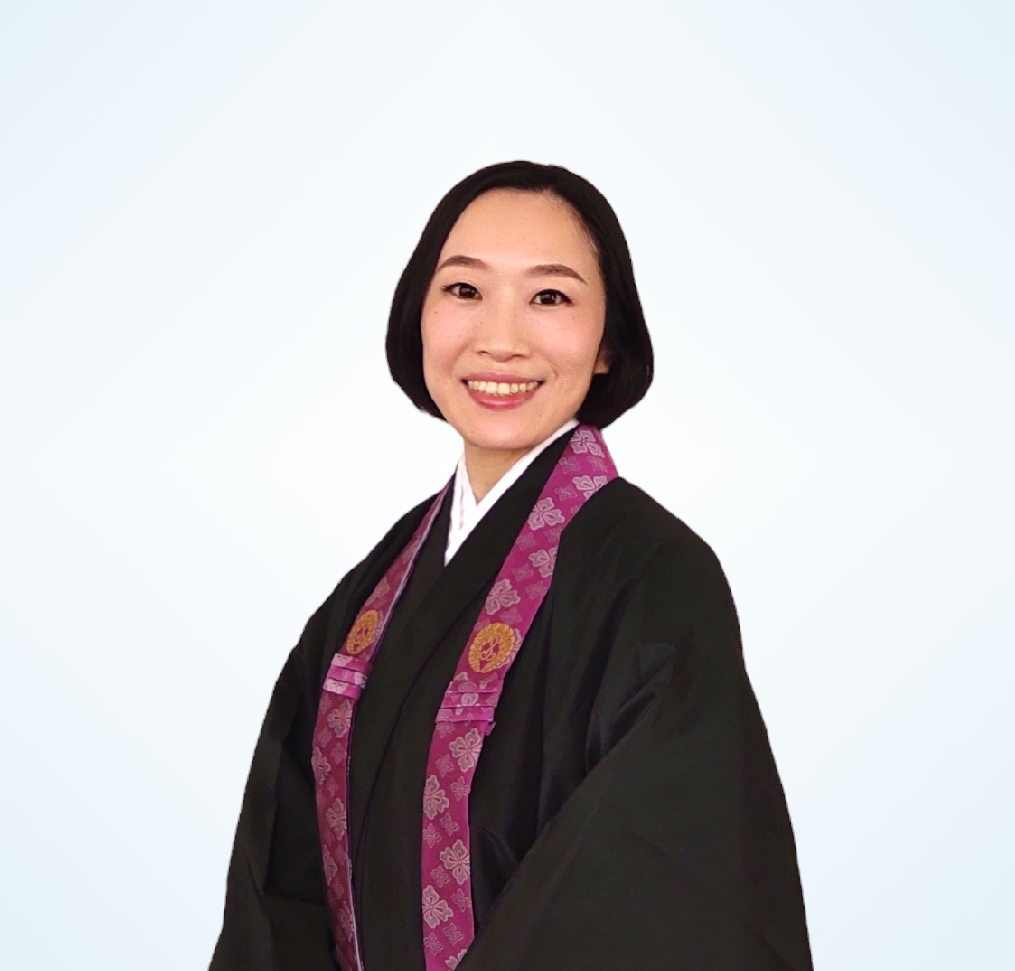
Reverend Yukari Torii
Resident Minister, San Fernando Valley Hongwanji Buddhist Temple
On a Saturday in June, we held a wedding ceremony for members of our sangha right here at our temple. I was so happy to share this precious and memorable moment with them and all their loved ones. After the ceremony, we had a beautiful wedding reception in the temple courtyard.
During the reception, sangha members put on an entertainment performance. We performed Bruno Mars’ song “Count on Me.” We added a skit of sorts to go along with the lyrics of that song. Bruno Mars is a Grammy Award-winning singer-songwriter. When I was in Japan, my husband Kuni was told by quite a few people that he looks like Bruno Mars. I’m not sure what you all here in America think about that, but that’s why Kuni participated in the performance in Bruno Mars cosplay!
Here are the lyrics to the first verse:
If you ever find yourself stuck in the middle of the sea I’ll sail the world to find you

If you ever find yourself lost in the dark and you can’t see I’ll be the light to guide you

We find out what we’re made of

When we are called to help our friends in need

You can count on me like one, two, three, I’ll be there

And I know when I need it I can count on you like four, three, two and you’ll be there

’Cause that’s what friends are s’posed to do, oh, yeah
At our performance at the reception, we changed “friends” to “mate.” Originally, this is a song about friendship. But when I really paid attention to these lyrics for the first time, I thought, “You can count on me like one, two, three, I’ll be there”—that’s what “Namo Amida Butsu” is all about. That’s what I want to talk about today.
In our Jodo Shinshu tradition, we often say “Namo Amida Butsu.” As you might have noticed, many ministers, including myself, say “Nanmandabu”—that’s a kind of dialectal variation.
One meaning of “Namo Amida Butsu” can be translated as “I entrust myself to Amida Buddha.” But, it’s Amida Buddha calling out to us in the first place, and we’re responding to that call. We’re not one-sidedly pleading like, “I’m entrusting myself to you, so please help me.”
“Namo Amida Butsu” is a call filled with the wish to bring you true happiness—a call that comes from the manifestation of infinite wisdom and compassion that is Amida Buddha. It’s Buddha calling out to each one of us: “I will guide you to true happiness, so count on me!”
What is happiness? Is it becoming billionaires like Elon Musk, Mark Zuckerberg, or Jeff Bezos? If we became billionaires, we could make big donations to temples and the BCA, which would be nice. But probably even they get caught up in worries—rocket ventures failing, new social media platforms emerging, sales declining. They probably never stop worrying about having to go higher, having to outdo others. Rather than that, isn’t true peace of mind found in having someone who says “You can count on me” and stays by your side?
“Count on Me” also has these lyrics:
If you ever find yourself stuck in the middle of the sea I’ll sail the world to find you
If you ever find yourself lost in the dark and you can’t see I’ll be the light to guide you
You can count on me like one, two, three, I’ll be there
Our lives have plenty of joy and fun, but we can’t avoid suffering and sadness either. For example, at school or work, you might face difficult situations that make you feel like you’re stranded in the middle of the ocean. Or you might have moments when you’re lost in complete darkness, not knowing which way to turn.
In times like these, if someone says to you, “I’ll sail the world to find you,” “I’ll be the light to guide you,” even if that difficult situation doesn’t get resolved immediately, you can feel reassured and encouraged—“This is tough, but I’ll get through it”—and find the strength to keep trying a little longer.
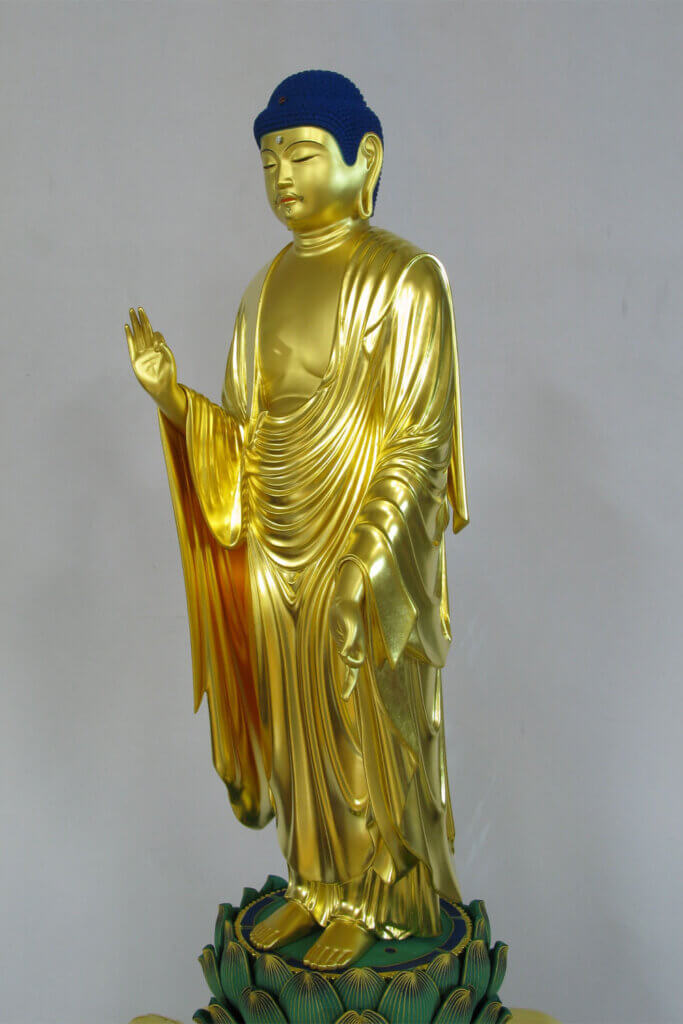
The one who speaks to you like this might be family, a partner, or friends. But even if you can’t immediately think of a specific someone, Amida Buddha is the one who continues to care for you without tiring and keeps calling out to you this way. “No matter how difficult your situation is, you can count on me like one, two, three, I’ll be there”—that’s Amida Buddha, never taking compassionate eyes off you. This caring of Amida Buddha for me is expressed in the standing statue of Amida Buddha.
There are actually many different Buddhas, not just Amida Buddha. They’re represented in various forms as Buddha statues. Amida Buddha statues come in both seated and standing forms. The photo at right is the famous giant statue of Buddha in Kamakura, Japan. It’s one of the tourist destinations relatively close to Tokyo. This Buddha is a seated Amida Buddha. The seated posture represents the quiet state of mind of one who has achieved enlightenment and has been freed from all mental afflictions.
On the other hand, in Jodo Shinshu temples, all the statues are basically standing. This represents the dynamic working of one who has achieved enlightenment. Through enlightenment comes perfect wisdom, which allows Buddha to see through all our suffering and sadness completely. And from this wisdom arises deep compassion—a compassion so profound that Buddha cannot help but rush to rescue each one of us when we’re in difficult situations.
For example, imagine it’s winter and you’re having a cozy family gathering. You notice your precious little child or grandchild walking toward a fireplace with flames blazing red-hot. What would you do? Before you could even shout “Watch out!” your body would instinctively start moving toward that child to keep them from harm. It’s like a parent’s love for their child. To Amida Buddha, I’m like a child who might get into trouble the moment their parents look away, and Buddha just can’t sit still.
And Buddha is not just standing there meaninglessly. Buddha is always ready to rush to outside at any moment. You can see this when you look at Amida Buddha statues in the Jodo Shinshu style from the side.
Think of Michael Jackson’s anti-gravity lean in “Smooth Criminal.” Not quite 45 degrees like Michael, but Amida Buddha statues lean forward slightly like this, as in the photo at right. This statue represents the moment just before rushing to your side, already beginning to move. The deep compassion and caring toward us of “I’ll be right there with you in one, two, three counts!” is expressed in this posture. And Amida Buddha continues speaking to us, “So rest assured, you can count on me! Namo Amida Butsu.”
How would you feel if someone tells you: “Whatever happens to you, I’ll sail the world to find you, I’ll be the light to guide you, You can count on me like one, two, three, I’ll be there”? Along with feeling reassured, wouldn’t gratitude overflow from your heart with a sense of relief, and wouldn’t you naturally respond, “Yes, thank you”? That’s the “Namo Amida Butsu” that comes from our mouths.
To Amida Buddha, each one of us is as precious as a beloved child, and Buddha continues speaking to us “You can count on me like one, two, three, I’ll be there.” Because I receive this message, I feel deeply that even when facing difficulties, I am being reassured, healed, comforted, and encouraged. Through listening to “Count on Me” for the wedding performance, I’m so grateful and happy that I was able to reflect on Amida Buddha’s caring heart toward us.
How would you feel if someone tells you: “Whatever happens to you, I’ll sail the world to find you, I’ll be the light to guide you, You can count on me like one, two, three, I’ll be there”? Along with feeling reassured, wouldn’t gratitude overflow from your heart with a sense of relief, and wouldn’t you naturally respond, “Yes, thank you”? That’s the “Namo Amida Butsu” that comes from our mouths.
To Amida Buddha, each one of us is as precious as a beloved child, and Buddha continues speaking to us “You can count on me like one, two, three, I’ll be there.” Because I receive this message, I feel deeply that even when facing difficulties, I am being reassured, healed, comforted, and encouraged. Through listening to “Count on Me” for the wedding performance, I’m so grateful and happy that I was able to reflect on Amida Buddha’s caring heart toward us.
Namo Amida Butsu